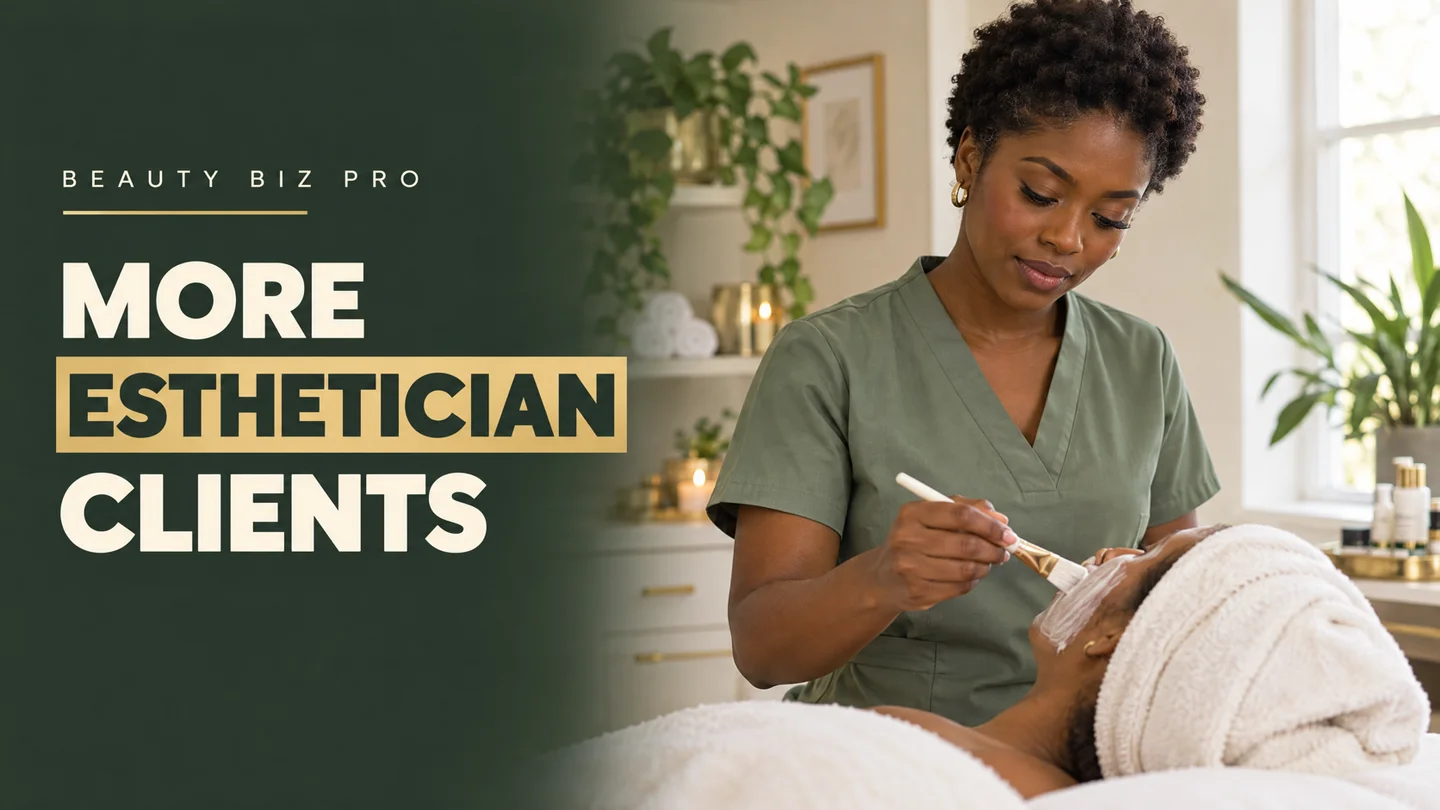
To get more esthetician clients, choose one service you want to fill, make it easy to understand and book on a phone, answer questions before they turn into lost inquiries, and plan the return visit from the first appointment. Posting more often will not fix a schedule where the right openings are hard to find or a reply takes a day.
This guide is a working plan for a solo esthetician, a suite owner, or a small spa: pick the appointments to fill, fix the first-visit path, choose one way to reach nearby clients, reply well, and measure what happens after booking.
Decide which appointments you are trying to fill
“More clients” is too broad to guide a post, an ad, or a reply. Choose one service and the openings you can actually offer a new client.
A first facial, a back facial, and a series consultation can need different time, preparation, and follow-up. An empty hour is useful only if the service you promote fits it and you have the energy and room to deliver it well.
Use this worksheet for the coming two weeks:
| Planning question | What to record |
|---|---|
| Which service are we promoting? | One service with the same name as your booking menu |
| Who performs it? | You, or the named provider |
| When can a new client come in? | Real dates and times |
| How long does the visit need? | Booking length plus room turnover |
| What stays reserved? | Regular clients and personal time |
| What counts as success? | First visits attended in those openings |
Illustrative calculation: an esthetician has two free afternoons of 150 minutes each. If a first facial needs a 75-minute block including turnover, each afternoon fits two first visits, so four in total. Scattered 30-minute gaps across the week do not add up to more facials. These numbers show the calculation; they are not recommended service lengths or a growth target.
Make the first visit easy to picture
People booking an esthetician for the first time are often unsure what to book, what happens in the room, and whether their skin concern is a fit. Every unanswered question is a reason to wait.
Your booking page or service page should show:
- The service name exactly as it appears in your booking menu
- Who performs it, with a real photo of you and your room
- What a first visit includes, in plain words
- Where you are, parking, and arrival instructions
- Your cancellation and rescheduling terms
- A way to ask a question before booking
Keep suitability questions with the professional. If someone asks whether a treatment is right for a skin condition, the answer should come from you after a consultation, not from a page or an automated reply.
Illustrative first-visit copy: “Your first facial starts with a short conversation about your skin and routine. I will explain what I recommend before we begin, and you can ask questions at any point. Plan for about 75 minutes, including time to settle in.”
Help nearby clients find you
Most esthetician clients choose someone within a short drive. Local visibility usually matters more than a large following.
- Google Business Profile. Use your real business name, service categories, hours, photos of your space, and services with plain descriptions. Ask for reviews consistently and reply to them.
- Instagram and TikTok. Treat them as proof that you are real and skilled, not as the booking system. Put one booking link in your profile and point every post to the same next step.
- Referral partners. Hair stylists, lash artists, brow artists, and fitness studios near you already see the clients you want. Give them one service to recommend and a simple way to send people to you.
- Existing clients. Ask happy clients directly: “If a friend asks where you get facials, here is my booking link.” A referral works better when it is easy to pass on.
Choose one of these to improve over the next two weeks rather than starting all four at once.
Decide whether paid ads make sense yet
Paid ads can bring new people quickly, but they amplify whatever happens after the click. If your booking page is confusing or replies are slow, ads make that problem more expensive.
Run ads when you can answer yes to all three:
- You know which service and openings you are promoting.
- A stranger can book that service on a phone without messaging you first, or gets a fast, useful reply if they do message.
- You can see which inquiries came from the ad and whether they booked and attended.
Our Facebook versus Google Ads guide covers which channel fits which problem.
Reply with an answer and a clear next step
Many inquiries are lost in the gap between “How much is a facial?” and a reply the next morning. A short, useful answer sent quickly often matters more than a perfect one sent later.
Illustrative reply to a price question: “Thanks for asking! Our first facial is [your price] and takes about 75 minutes, including a short skin consultation. I have Thursday at 2:00 or Saturday at 10:30 open. Would either work, or would you like me to send the booking link?”
Answer the question they asked, give real options, and make the next step obvious. If you are with clients all day, decide how inquiries are covered during appointments and after hours. An automated acknowledgment should set expectations honestly and should not pretend a person has read the message. Explore inquiry follow-up support if slow replies are the obstacle, with the workflow defined before setup.
Plan the second visit from the first
Many skin goals take more than one visit, so the return visit is part of getting the client, not an afterthought. You recommend the timing; your process makes the next booking easy.
At checkout, one question is enough: “Would you like to book your next visit now, or would you prefer I send you a reminder?”
Record whether the client booked again and whether they attended. Do not count a future booking as a completed return visit, and keep new clients and returning clients in separate columns so growth in one does not hide a drop in the other. Our guide on why beauty leads do not book walks through the full path from inquiry to return visit.
Run a focused four-week plan
Change one meaningful part of the path at a time and write down what you changed. Four weeks is a planning period, not a promise of a particular result.
| Week | Action | Evidence to keep |
|---|---|---|
| 1 | Choose the service and confirm real openings | Capacity worksheet |
| 2 | Fix the first-visit page and test booking on a phone | Questions found and fixes made |
| 3 | Improve one way nearby clients find you | Source, inquiries, booked first visits |
| 4 | Review attendance and offer the return visit | Attended visits, rebookings, open questions |
Keep tracking return visits after the four weeks. They often fall outside the first reporting window.
Download the esthetician client growth plan and fill in week one before adding more tactics. If you want help putting the plan into practice, explore marketing support for spa and esthetics businesses.