Spa ads for facials do not need a lower price. Advertise one treatment and give people a reason to book now. Two of the three offer shapes Beauty Biz Pro uses leave your rate alone: a complimentary consultation and an added enhancement. The third, a first-visit incentive, is worth it only under four conditions. Judge each campaign on treatments booked.
Free worksheet
Plan the facial you want more of and track what books
Confirm openings for one facial, write your reply to a price question, and follow one inquiry group to attended visits.
Get the esthetician client growth planBeauty Biz Pro is a marketing agency and growth platform for beauty professionals, founded by Jake Randolph. This guide shows when each offer shape fits and how to read one real campaign’s $7.65 cost per lead or message without mistaking it for a booking. That figure is ad platform data from one campaign and not a forecast; its source and limits are further down.
This guide is for spa and esthetics owners. Med spas with treatments under medical oversight should start with med spa patient acquisition, from lead generation to booked consultation. For the wider picture, see planning beauty ads around the appointments you want.
Do you have to discount facials to run ads?
No. Beauty Biz Pro runs spa ads with and without discounts, and we do not automatically ask owners to lower their prices. The offer is the reason to book now. It does not have to be a cheaper facial. Pick one of three shapes: a complimentary consultation, an added enhancement, or a first-visit incentive.
An offer is the reason to book this week instead of someday. The client gets something concrete for acting now: time with you, an extra in the room, or a lower first visit. Only the third touches your rate.
A discount in the headline does get attention, so the question is whose. A percentage off tends to pull in people shopping for the lowest number. You pay for the ad and give up margin on the visit. A price-led offer works best with past clients who already know your work. For new clients, the first-visit incentive below is the one exception, with conditions.
Which facial should your ad sell?
One treatment per campaign, not the whole menu, and name it the way a client describes what they want, not by the machine. If a stranger cannot tell from one sentence who the treatment is for and what the first visit includes, expect the ad to collect questions more than bookings.
Choosing which facial to lead with is covered in the full first-facial plan for estheticians. Once you have picked it, run three tests before it goes into an ad:
- The one-sentence test. One sentence a stranger understands: who it is for and what happens at the first visit.
- The client-words test. Name the concern the way clients say it, such as “breakouts that keep coming back”.
- The device-second test. A branded machine means a lot to you and little to someone scrolling. Lead with the visit; mention the device after, if at all.
Which offer shape fits your facial?
Match the shape to the treatment and your calendar. Use a complimentary consultation when the treatment is a program people need to talk through. Use an added enhancement when the facial must stay at full price. Use a first-visit incentive only when you have openings soon and the second visit is already planned.
Three offer shapes, side by side
| Offer shape | What it costs you | Use it when | Watch for |
|---|---|---|---|
| Complimentary consultation | Your time, in a slot that could hold a paid service | The treatment is a program or series people want explained before they commit | Book the treatment from the consultation, not days later by message. Skin recommendations stay with the esthetician. |
| Added enhancement | Treatment-room minutes and product. The facial price does not move. | The facial stays at menu price and you have an extra you already do well, such as [an add-on from your menu] | Name the extra in the ad. An extra nobody knows about is not an offer. |
| First-visit incentive | Part of the first visit’s price | You have openings in the next few weeks and a named second visit at menu price | It stays first visit only. Check the four conditions in the next section. |
Name the included extra in the ad. An extra you include on every visit feels routine to you. To someone new, a named extra reads as value.
One signature facial campaign we ran used a free consultation as its offer, according to Tony Cruz’s written report to Jake Randolph, September 2026. For the full approach, see how we market spas and esthetics studios.
When is a first-visit discount worth it?
Only when the second visit is planned before the first one is sold. Keep the incentive to the first visit, leave it off your profile and price list, and decide what the client books next at full price. If you cannot name that second visit, use a consultation or an enhancement instead.
Run a first-visit incentive only when all four are true:
- You have openings to fill in the next few weeks.
- You can name the second visit, and it is at menu price.
- The ad and the booking page say “first visit only” in writing.
- The incentive never appears on your profile, your highlights, or your price list.
An introductory offer pays for itself when the client stays for many visits, and loses margin when they come once for the low price. A promotion left on your profile makes your full price look like a markup to the next person who finds you. Before you set the incentive, work out your price floor first.
What a first-visit incentive has to pay back
The incentive costs you [menu price minus first-visit price] on every client who takes it, including the ones who never come back, on top of the ad spend that brought them in. Return-visit revenue is not the test. It pays when return visits at menu price, after the product and treatment-room time they take, leave you more than the incentive total plus the ad spend. Check it against your records: of your last [number] first-visit clients, how many booked a second visit at menu price?
-
First visit
Incentive applies
First visit only, as the ad said.
-
At checkout
Second visit booked at menu price
Named before the incentive ran.
-
Return visit
Menu price
The incentive is not mentioned again.
No records yet? Track return visits before you discount. Getting clients to rebook covers the asking and the reminders.
What should a facial ad say instead of a price?
Lead with the skin concern and the visit, not the amount. Name one concern the treatment is for, show the room and the person doing the treatment, say what the first visit includes, and end with one next step. Save the price for the reply. People book the experience they can picture.
An ad that opens with a facial and a price skips the reason anyone stops scrolling, the thing about their skin that bothers them, and invites comparison with every studio in the feed. Every facial ad needs four parts:
- Concern. One, in client words: “for breakouts that keep coming back”.
- Visit. What happens at the first appointment and how long it takes.
- Expert. Who does it, with a real photo of them in the real room.
- Next step. One action that matches the offer: book the consultation, claim the enhancement, or send a message.
A facial ad built on the concern, not the price
Solace Skin Studio (demo business)
A facial plan for breakouts that keep coming back
Start with a free skin consultation. [Your name] looks at your skin, asks about your routine, and explains what they recommend before any treatment is booked.
- One concern, in the words a client uses. No promise about what the treatment will do.
- What the first visit includes. The offer is the consultation, so the facial keeps its price.
- The expert and the room in a real photo. Never a before-and-after image.
- One next step, and it matches the offer in the ad.
Keep results out of the ad. What a treatment can do for someone’s skin is a conversation for the consultation, with the esthetician, not a headline. Still picking a platform? Start with choosing between Facebook and Google first.
What did one real facial campaign cost per lead or message?
$7.65 per lead or message: 55 of them on $420.79 of ad spend, for one acne treatment program campaign. The owner then reported several consultations and two treatment plans booked. A cost per lead or message is the price of an inquiry, not of a client. Judge your campaign on booked plans.
Anonymized campaign report
An acne treatment program campaign
- Leads or messages (ad platform)
- 55
- Cost per lead or message (ad platform)
- $7.65
- Ad spend (ad platform)
- $420.79
- Treatment plans booked (owner reported)
- 2
- Consultations (owner reported): Several
Source: Ad platform data for one campaign, plus the owner's report of bookings from it. From Tony Cruz's written report to Jake Randolph, Beauty Biz Pro's founder, dated September 28, 2026. Period: Not supplied
What this does not show
- One campaign. Not a forecast for your business.
- A lead or message is an inquiry, not a booking. The two treatment plans are the owner's report.
- The owner also reported several consultations; the exact number was not supplied.
- Treatment plan value was not reported, so no revenue or return on ad spend is calculated.
This report does not say which offer the campaign ran, so it does not prove one offer shape beats another. Use it for what it does show: $7.65 bought an inquiry, and two of those inquiries became treatment plans by the owner’s count.
Read the number against the offer, not against someone else’s campaign. A price-led ad can push the cost per lead or message down and still book fewer treatment plans, because the cheapest leads are often people shopping for the lowest number.
Count four numbers for the same group of inquiries:
- Leads or messages
- Consultations booked
- Treatments or plans booked
- Visits attended
A lower cost per lead or message does not make an ad the winner. Before you call one ad better than another, compare the same dates’ inquiries on spend, attended treatments, and what those treatments leave you after product and treatment-room time. Set the spend limit and the review date before launch. Judge inquiries from a fixed set of dates once their consultations have happened, not the morning after the ad goes live.
Client names are withheld. See more anonymized campaign reports.
What do you reply when the first message is “how much?”
Give the price, ask one question, and offer a time. A first message of “how much?” usually means the person does not know the next step, not that they are a bargain hunter. Ask what they want help with, recommend the facial that fits, and offer two real openings. Skin questions stay with the esthetician.
- Answer the price, together with the offer. Restate what the ad promised: the free consultation or the included enhancement. The number then arrives with what the first visit includes, instead of on its own.
- Ask what they want help with. One question about their goal, so you recommend the right facial instead of leaving them to pick from the menu.
- Offer two real times and one next step. Only times your calendar can confirm.
A reply to someone who saw the consultation ad
- Client
Saw your ad. Is the consultation really free? And what does the facial cost after that?
- Solace Skin Studio (demo business)
Yes it is free! Facials start at [your price]. You can book on our website.
- Answers both questions and stops.
- Says nothing about what the consultation includes.
- Leaves them to find a time alone.
- Client
Saw your ad. Is the consultation really free? And what does the facial cost after that?
- Solace Skin Studio (demo business)
Yes, the consultation is free. [Your name] looks at your skin, asks about your routine, and recommends a plan. The [treatment name] is [your price] per session, and you decide at the consultation. What are you hoping to get help with? I have [day] at [time] or [day] at [time] open.
- Confirms the offer from the ad, then gives the price.
- Asks one question about their goal.
- Offers two real times for the next step.
We help owners with these replies as part of a campaign, because the ad only starts the conversation. If inquiries stall even with a good reply, read why inquiries stall before they book.
When should the follow-up run without you?
When form and ad inquiries arrive while you are mid-facial or after hours, and replies go out hours later. Speed-to-Lead sends a first text you approved, then a short follow-up if they go quiet, and stops when the person replies, books, or opts out. Questions about their skin still come to you.
Speed-to-Lead is part of Beauty Biz AI, Beauty Biz Pro’s platform for booking and follow-up systems. It covers website forms, ad lead forms, and booking pages: a text when the inquiry arrives, an email with the details, and one more text later that day if there is no reply. Instagram and Facebook messages are not part of this flow. Decide who answers those, and when, between appointments, before the ad goes live.
Automate it when all three are true:
- Inquiries land while you are with clients or after hours.
- Your first reply regularly goes out hours later.
- You are ready to approve the messages, the timing, and the stop rules.
If your replies already go out promptly, keep doing it by hand. The follow-up handles scheduling and general questions only. It does not assess skin or recommend treatments.
Sources
The campaign figures are ad platform data, and the consultations and treatment plans are the owner’s report, both from the written report by Tony Cruz, Beauty Biz Pro’s head coach, to Jake Randolph, its founder, dated September 28, 2026. The three offer shapes and the signature facial example come from the same report. Teaching points are paraphrased from Beauty Biz Pro classes for owners held between April and October 2026. Client names are withheld. Offer tables, ad wording, replies, and math are illustrative.
Free worksheet
Plan the facial you want more of and track what books
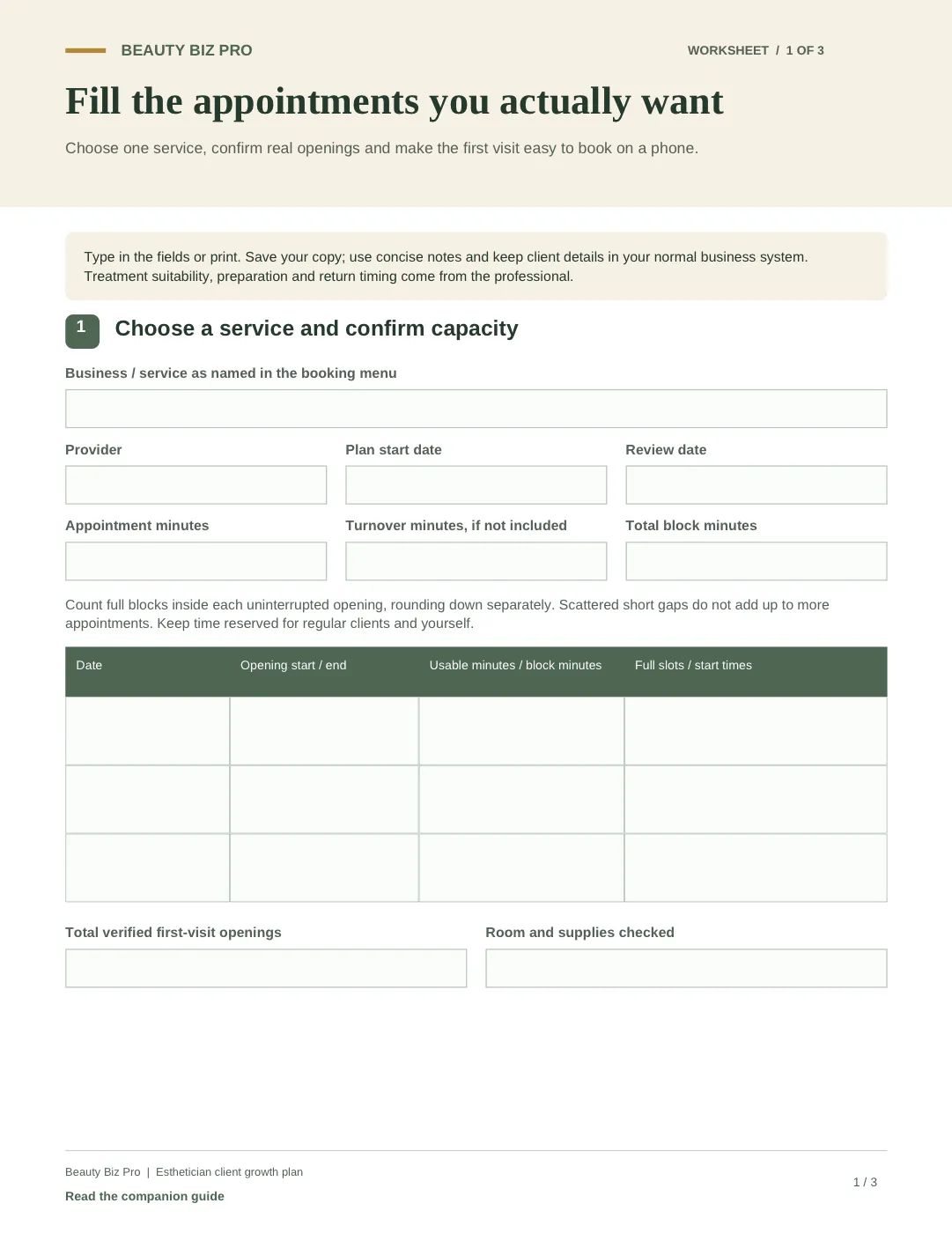
Use the esthetician client plan for this guide: confirm real openings for the one facial, check the page your ad sends people to, write your reply to a price question in the channel section, then follow one group of inquiries to booked and attended visits.
Inside
- Choose a service and confirm capacity
- Check the first-visit page
- Improve one way nearby clients find you
- Review the same inquiry group
Want help doing this?
Want the facial campaign and the replies run together?
For spa and esthetics owners we pick the treatment and the offer with you, run the ads, and set up the follow-up through Beauty Biz AI. The spa page explains the scope and how a strategy call works.
See spa advertising help