Run med spa Facebook ads one treatment at a time, from Ads Manager, with one next step: a message or a consultation request. Ads Manager will tell you what a conversation cost. It will not tell you who booked or showed up; your calendar does. Get the ad approved, name who answers, then judge it on consultations booked and attended.
Free worksheet
Plan the consultation behind the ad
Confirm the consultation openings, check where the ad sends people, set the reply rules, then count each stage.
Get the med spa consultation planThis guide covers the marketing and operations side of Facebook and Instagram ads for a medical spa owner or practice manager, drawn from how Beauty Biz Pro plans and runs med spa campaigns. Treatment questions, results and who a treatment suits stay with your medical director and providers. For everything from inquiry to booked treatment, see med spa patient acquisition, from lead generation to booked consultation. For other beauty businesses, see planning beauty ads.
How do I run Facebook ads for a med spa?
To advertise a med spa on Facebook, run it from Meta Ads Manager, not the boost button, and build each campaign around one treatment with one next step. Before launch, have your medical director or compliance reviewer approve the copy, images and offer, name who answers every message, and agree which counts you will check.
- Pick one treatment your providers have consultation time for. Name it the way it appears in your booking system, and confirm the openings before the ad runs. The first section of the consultation plan, “Choose a consultation and confirm capacity”, holds the capacity check.
- Pick one next step. Start a conversation, request information, or book a consultation. One ad, one action.
- Pick the destination. A message thread, a lead form, or a landing page. The comparison below shows what each one asks of your team.
- Write a plain, local ad and send it for review. Name the treatment and the area you serve. Your reviewer signs off on the copy, image, offer, targeting and destination before launch. The approval log lists each line.
- Name the reply owner and a backup. Clinical questions go to a provider, with a named owner and a response time.
- Write down what you will count and when you will review it. Conversations or leads come from Ads Manager. Consultations booked and attended come from your calendar. Pick the review date before launch and give the inquiry group time to book and attend; a cost per message from the first days says nothing about consultations yet.
Not ready yet if: no provider has consultation openings for the treatment, no one can answer messages during the hours the ad runs, or any line on the approval log is open. Fix that first; the ad will only make the gap bigger.
Why build each campaign around one treatment?
Build each med spa campaign around one treatment because one ad can answer one person’s questions, not six. Someone weighing a facial and someone weighing a laser series need different facts before they book. At Beauty Biz Pro we build campaigns around a specific treatment and a clear next step, not one universal offer for every practice.
Decision rule: if you need the word “or” to say what an ad is for, it is two ads.
| One treatment, one next step | Monthly special with six treatments |
|---|---|
| The prospect knows what the ad is about | The prospect has to work out which item is for them |
| One next step: message or book a consultation | Several offers, no clear action |
| The reply starts with that treatment | The reply starts with “which one?” |
| Counts belong to one treatment | Counts mix treatments and cannot be compared |
One of Beauty Biz Pro’s med spa campaigns was built around a single HydraFacial treatment. It ran several ads for that one treatment, sent people to a Messenger conversation, and showed no discount in the creative. That comes from Tony Cruz’s written report and the campaign’s own ad records.
One treatment does not mean opening the ad on a device name. Tony’s point in a recorded class: the brand name of a machine means a lot to you and very little to the person scrolling. The ad still names the treatment so the right people respond, then speaks to the prospect’s situation and the next step. Results and benefit wording goes through the approval log.
Make the call-out local. Name the area you serve, so people outside it scroll past and the conversations you pay for come from people who can reach you. For the rest of the practice side, see how we market med spas.
A one-treatment message ad on a phone
Sponsored
[Treatment name] consultations in [your area]
Thinking about [treatment]? Message us to ask about a consultation with [provider name] and see times this week.
- One treatment and a local call-out.
- The prospect's situation and one next step. No outcome words.
- One action.
- The destination your team has to answer.
Should the ad start a message, a lead form, or a landing page?
Choose by who can reply and what the treatment needs. Use a message ad when someone can answer during the hours the ad runs. Use a lead form when your team will text or call the same day. Use a landing page when the consultation needs explaining first and you have an approved page that books on a phone.
| Destination | What the prospect does | What Ads Manager counts | What it needs from your team |
|---|---|---|---|
| Message ad | Starts a thread in Messenger | Messaging conversations | Someone answering in real time, with real consultation times |
| Lead form | Submits contact details on Facebook | Leads | A fast first text or call, and no health questions on the form unless approved |
| Landing page | Reads about the consultation, then books or asks | Clicks, or the conversion you set up | A page your reviewer approved and a booking step that works on a phone |
Tony prefers the message ad, because it puts your team in a live conversation with the person who tapped. Our single-treatment HydraFacial campaign used that route. Jake Randolph, our founder, covers the other two in a recorded class: the team goes back and forth between a lead form and a landing page depending on the offer and the service.
If you are still deciding between Meta and Google, start with Facebook or Google Ads.
What should I count after a med spa Facebook ad runs?
Count four things for the same group of inquiries: conversations started, consultations booked, consultations attended, and conversations that have not booked yet. Ads Manager reports only the first. Your calendar holds the rest. A low cost per message says nothing yet about consultations, so agree these counts before launch. Booked and attended mean what they say. Two need a definition:
- Conversation: someone starts a message thread with the practice. Ads Manager counts it. For a lead form or a landing page, this row is the lead or the conversion you set up.
- Not booked yet: interested and still deciding. They get a follow-up, not a write-off.
Tony’s written campaign method covers the whole path, not only the ad: the offer, qualification, follow-up and consultation booking, with clinical questions going to the provider. Qualification here means scheduling fit: which treatment, what timing, which location.
Jake’s point from a recorded class: the platform shows how many people you reached and what each message cost. What it cannot show is who booked and who arrived, so decide before launch who pulls the calendar counts, and on what day.
Who counts each stage, per ad
| Stage | Who counts it | Where the number comes from |
|---|---|---|
| Conversation started | Ads Manager | The ad’s results column, per ad |
| Consultation booked | Your practice | Your calendar, for the same inquiry dates |
| Consultation attended | Your practice | Your calendar, arrivals only |
| Still deciding, in follow-up | Your practice | Your follow-up list, with a stop rule |
Keep the counts per ad. When several ads run for the same treatment, the ad with the cheapest conversation is not automatically the one that fills consultations. You only find out by following each ad’s conversations to the calendar.
If conversations come in and consultations do not, check the stages after the ad before you rewrite the ad. Our guide on why inquiries do not book walks through finding the stage where they stop.
Who answers the conversation, and what goes to the provider?
Name one person who answers ad conversations, plus a backup, before the ad goes live. Reply first with a practical question and real consultation times. Anything about whether a treatment suits someone, medications, side effects or results goes to the provider. Automated replies handle scheduling and approved general information only, never clinical advice.
A message ad starts the reply clock the moment someone taps. Jake’s point from a recorded class: if you click an ad and hear nothing back, you may forget you asked. Set this up before launch:
- Reply owner and backup named, with the hours they cover.
- The first reply asks one practical question: which treatment, what timing, which location.
- Real consultation times offered only after someone checked the calendar.
- Clinical questions handed to the provider with the conversation attached, with a named owner and a response time.
- An automated acknowledgment never pretends a person has read the message.
“How much is it?” is a normal first message, not a bad lead. Tony’s point: most people do not know what else to ask yet. Thank them, ask one practical question, and offer the next step.
The most ordinary first message, answered two ways
- Client
How much is it?
- Your practice
Please call the office for pricing.
- Sends them to a phone call they may not make
- Asks nothing about what they want
- Client
How much is it?
- Your practice
Thanks for asking about [treatment]. Are you hoping to come in this month, or just starting to look? I can send our pricing and two consultation times this week.
- Thanks them first, as Tony does, then asks one timing question
- Offers a next step without a price in the message
The line between what an automated reply may answer and what goes to your provider is in what AI follow-up can answer for a med spa.
For lead form inquiries, Speed-to-Lead, part of Beauty Biz AI, texts and emails each new inquiry from messages you approve, and stops when they reply, book or opt out. Messenger conversations stay with your named reply owner. The full reply and handoff setup is in the consultations guide.
What has to be approved before a med spa ad runs?
Everything in the ad and behind it: copy, images, the offer, the targeting, and the form or page it sends people to. Ads for medical and cosmetic treatments can face extra platform and state rules that change, so have your medical director or compliance reviewer check them before launch. Expect some ads to need changes after Meta reviews them.
Use this as the approval log. Each line gets a reviewer’s name and a date.
- Ad copy: no promised results, no superlatives, no outcome words your reviewer has not approved.
- Images: your real space or team. Any result imagery is approved for that use, with the client’s written consent documented the way your practice requires.
- Offer: approved by your reviewer, including any discount or package terms.
- Targeting: checked against the current policy by your reviewer.
- Destination: the page or form is approved; health questions appear only on tools your reviewer approved.
- Tracking: any pixel or conversion event on the page or form is approved by your reviewer, because it can send visit details to Meta.
- Prerequisites: everything the practice needs in place for this treatment is complete.
Decision rule: if any line is open, the ad waits. Launch the day the list is complete, not the day the creative is ready. We have paused a med spa campaign until compliance prerequisites were in place.
Next step
Fill in the consultation plan before you build the first ad. Use “Local visibility and ads” for the approval check, “Define the reply rules and clinical handoff” for who answers, and “Review the same inquiry group” for the counts. Running more than one ad? Fill in that last section once per ad. Bring your questions to the free community, where other owners are working through the same steps.
Sources
The HydraFacial campaign description comes from Tony Cruz’s written report to Jake Randolph on September 28, 2026, and the campaign’s saved ads and Ads Manager records. Tony’s campaign method and the paused campaign come from the same written report. None of these records is shown, because they identify the practice. Teaching points are paraphrased from recorded Beauty Biz Pro classes on April 7, June 16, August 13, August 25 and September 15, 2026. The six steps, destination table, measurement ladder, approval log, ad wireframe and replies are original planning tools, not measured client results. This page does not state Meta’s advertising policy; your reviewer checks it.
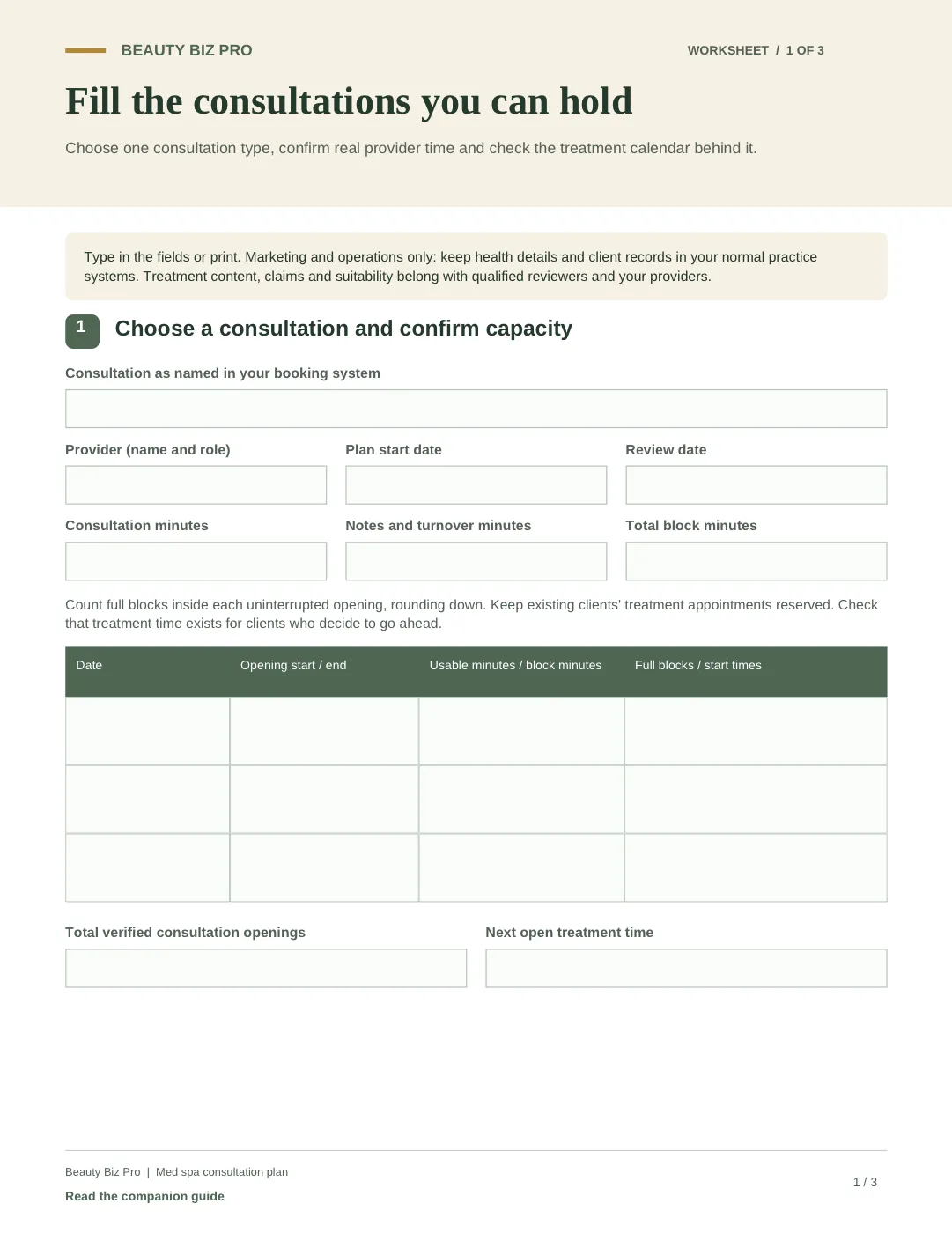
Free worksheet
Plan the consultation behind the ad
Confirm the consultation openings the ad will fill, check the page or form it sends people to, set the reply rules and clinical handoff, and review one inquiry group by stage.
Inside
- Choose a consultation and confirm capacity
- Check the consultation page
- Local visibility and ads
- Define the reply rules and clinical handoff
- Review the same inquiry group
Want help doing this?
Want the ad and the follow-up run together?
See how we build med spa campaigns around one treatment, with the next step, the follow-up and the approvals agreed with your practice before anything goes live.
See how we run med spa ads205 messaging conversations at $5.26 per conversation from one ad in a HydraFacial campaign.
Ad platform data from Tony Cruz's written report dated September 28, 2026. Not a forecast. A conversation is a message thread, not a consultation. See the report